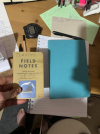
'dear all users who replied in this thread to motivate me such as also
'
@edward @Dave Edwards and the first user mark
- I could picture the first type of 2 different style note books I obtained on my desk *
please see
View attachment 2387
My 2 new note books (for X-mas) one on the right was from user
@Mark R (about 300 pages for 10£ it was?, then on the left is cheap 80 page (about half the size, -
I started writing first in the big 'stationary island back page with title (portable memory bank - making actually using it for a reason/purpose (which is probably different like completely (to the entire/whole reason which cal newport wrote the subtitle (get a type of 50$ journal! - and the reason i was writing now - was like trying to further best /decide or manage how to use - ' the 2 note books (with the purpuposes 1 system to go to - e.g. (I don't want to ruin them, messy
"then i could expliain - that I got a type of free document called "win wengers brain boosters" online- made it into a type of ME PDF format ,making anotation notes , trying to keep simple - and he says read 1 chapter per day
in the first chapter it is portable memory bank, it reads " COPY RIGHT SAFE QUOTE "
Exercise 1: The Portable Memory Bank
The key to being more creative is to have a quick, convenient, easy way to respond to your own
ideas and then to take initiative with them. This first exercise is a fundamental tool that is at
the core of Dr. Wenger’s work. He suggests that you carry around with you, EVERYWHERE,
either a notepad and pen or a small pocket tape recorder with mike. For a while, EVERY time
you catch yourself thinking, EVERY time you catch yourself having an idea good or bad,
EVERY time you notice something in your perception or awareness, jot down in that notepad
or record in that recorder your idea, perception, or awareness. He calls this tool a “Portable
Memory Bank.”
If you record even as few as fifty ideas per day for five days in a row, it will literally be like
you’ve found yourself in an altogether different world. You will unveil an awareness and
perception that enriches and enhances your life. Record even as few as thirty observations per
day for as few as three straight days. Write down any specific perceptions on anything that
comes to mind, both around you and within you, and you’ll truly find yourself in a wonderful,
richer universe.
W"
(first 2 paragraphs)
so this is the first purpose (which i am using my large blue journal for on the back page - maybe the users tag here could (help me suggest actually - how's best to use the other space/sections in my journals (other than GTD contexts- which
@GTD solo-student wrote which is seriously struggling with my ADHD?), the spaces in them *
"
Win suggests that you record your observations and ideas on anything and everything. He
reminds you that you are never certain whether an idea is good or bad until you’ve got it out on
the table. So he encourages you to record the whole insight or idea BEFORE you decide
whether it’s good or bad. Some ideas may seem silly, but you will find that many will be good.
You may also find that some of the ideas that seemed to be the silliest, once you really look at
them, will turn out to be terrific. Be sure not to edit yourself until AFTER you’ve fully
expressed, recorded, and mulled through an observation or idea."
54 idea


 for eye health